Thinking about a new dock or boatlift at your Harbor Acres home? The permitting process can feel complex, especially with Sarasota Bay’s shallow waters and sensitive seagrass beds. You want a streamlined path that respects the environment and protects your investment. This quick overview gives you the essential steps, timelines, and design tips tailored to Harbor Acres so you can plan with confidence. Let’s dive in.
The permitting path in Sarasota
You will touch three levels of review for most bayfront docks in Harbor Acres: local, state, and federal. Many homeowners begin with Sarasota County to confirm local rules and site constraints. Most projects also require state authorization over sovereign submerged lands and a federal review for work in navigable waters.
Sarasota County review
Start with the county. Sarasota County evaluates your site plan, coastal setbacks, floodplain rules, and building requirements for docks, piers, and lifts. The county may coordinate with state or federal agencies and will issue local approvals and inspections for construction.
Florida state authorization
If your dock extends waterward of the mean high water line onto state-owned submerged lands, you will need authorization from the Florida Department of Environmental Protection. Depending on the footprint and use, the state may issue a consent, easement, or lease. If your project includes dredging, fill, or impacts to wetlands or surface waters, an Environmental Resource Permit may also be required, administered by FDEP or the Southwest Florida Water Management District.
Federal review by USACE
The U.S. Army Corps of Engineers regulates work in navigable waters and any dredge or fill. Small private docks can often proceed under a general or nationwide permit with a verification process. Projects that affect navigation or seagrass, or that involve dredging, may require an Individual Permit with public notice and a longer timeline.
Other agency touchpoints
Additional coordination can include the Florida Fish and Wildlife Conservation Commission for manatee protection measures and timing restrictions. NOAA and state marine programs may weigh in when seagrass or essential fish habitat is affected. Utilities, navigation districts, and neighboring owners may also be part of review or notice requirements.
When you need permits
- Sarasota County: Any dock, fixed pier, floating dock, or lift that changes shoreline structures or water access.
- FDEP sovereign submerged lands: Any structure waterward of the mean high water line on state-owned bottom.
- Environmental Resource Permit: If you propose dredging, filling, or altering wetlands or surface waters.
- USACE: Work in navigable waters or any dredge or fill activity, even for small private docks.
- FWC and related agencies: Construction near manatee habitat or seagrass beds often triggers protective measures.
Typical timelines in Harbor Acres
For straightforward docks that avoid dredging and seagrass impacts, Sarasota County review often takes a few weeks to a few months. State authorization for submerged lands can take several weeks to a few months for routine cases, longer for leases or larger footprints. Federal nationwide permit verifications commonly run about 30 to 60 days for simple projects, while Individual Permits can take 6 to 12 months or more. Environmental Resource Permit timelines vary and may range from a few months to half a year or longer if mitigation is required.
What slows approvals
- Presence of seagrass or other protected habitats that require surveys, avoidance, and mitigation.
- Proposed dredging or boat basin creation.
- Public notice periods and interagency coordination.
- Requests for additional information due to incomplete packages or outdated surveys.
- Neighbor objections and navigation or boating safety concerns.
- Seasonal restrictions for manatees or sea turtles and required mitigation sequencing.
Required surveys and documents
Plan ahead for a complete submittal. Common requests include:
- Certified survey with property lines and the mean high water line.
- Bathymetric survey with tidal datum reference.
- Recent seagrass or submerged aquatic vegetation survey, often within the last 12 months.
- Site plan with dimensions, pile layout, decking material, ramps, floats, and lift locations.
- Structural drawings and calculations for fixed structures and boatlifts when required.
- Construction methods, including pile-driving approach and turbidity controls.
- Evidence of upland ownership and riparian rights, plus neighbor notifications if needed.
- Mitigation plan if impacts to seagrass or other aquatic resources are proposed.
Harbor Acres design tips that work
Sarasota Bay is a shallow estuary with tidal flats and nearshore seagrass. Many Harbor Acres owners prefer boatlifts to avoid dredging and to keep vessels dry in shallow water. Thoughtful siting and lighter footprint designs speed approval and reduce long-term impact.
Dock types at a glance
- Floating docks: Lower profile and smaller footprint in shallow water. Still need piles or anchors and state authorization over sovereign submerged lands.
- Fixed, pile-supported docks: Stable and compatible with boatlifts. Fewer but larger piles and open-grid decking can reduce shading and seagrass impacts.
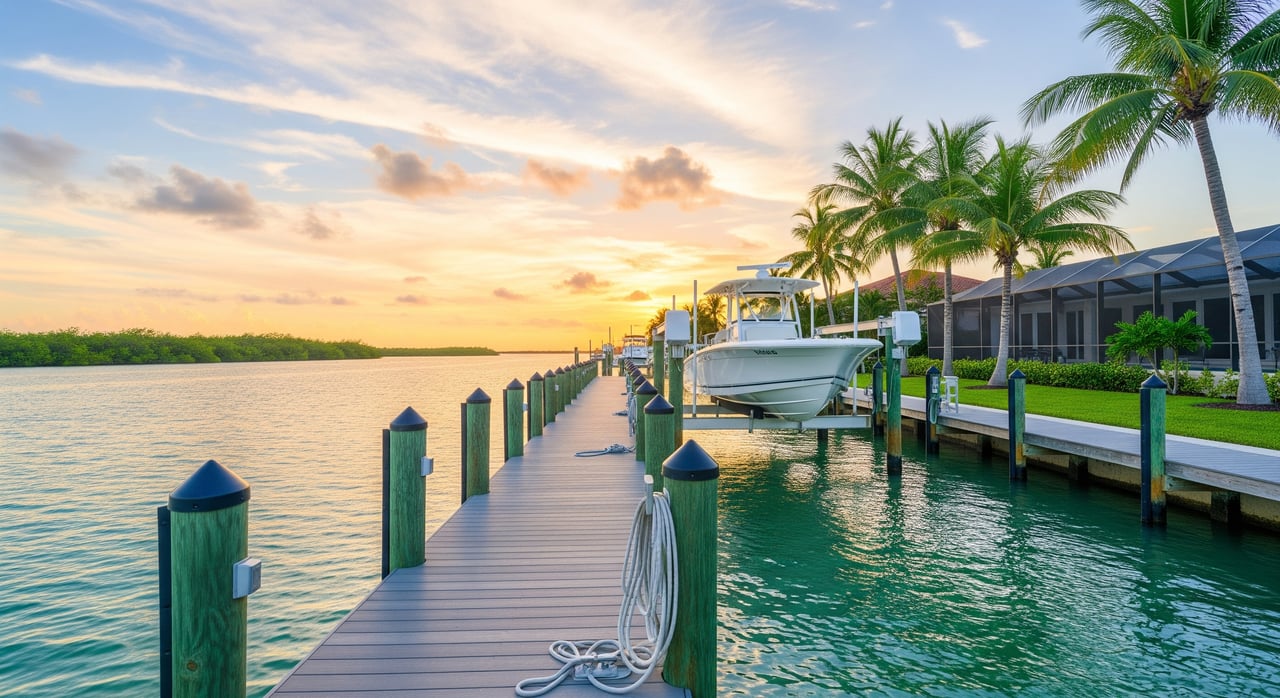
- Boatlifts and davits: A practical solution for shallow frontage. Site lifts to avoid seagrass, plan clearances for loading and safe navigation, and keep the overall footprint efficient.
Minimize environmental impacts
- Use open-grid or high-transparency decking to let light reach the bottom.
- Reduce pile number and diameter, and increase spacing where feasible.
- Avoid dredging where possible. If unavoidable, minimize volume and include silt control.
- Choose non-toxic, approved marine-grade materials.
- Specify vibratory pile driving when suitable to limit turbidity and noise.
- Orient structures to respect navigation lanes and neighbors’ riparian zones.
Safety, utilities, and resilience
- Plan electrical with proper conduit methods and GFCI protection. County electrical permits typically apply.
- Integrate lighting and railings to balance safety and wildlife considerations.
- Design for Florida wind and wave loads per county and code standards.
- Use corrosion-resistant metals, coatings, and fasteners suitable for saltwater.
A simple step-by-step plan
- Schedule a pre-application conversation with Sarasota County permitting to confirm local rules and setbacks.
- Hire a licensed marine contractor and surveyor with Sarasota Bay experience. Order a certified boundary and mean high water survey, bathymetry, and a current seagrass survey if you will work waterward.
- Confirm whether your structure will occupy sovereign submerged lands. Engage FDEP on consent, easement, or lease requirements early.
- Ask your contractor to confirm USACE jurisdiction and whether your project fits a general or nationwide permit or requires an Individual Permit.
- Assemble a complete packet: site plan, structural drawings as required, construction methods, environmental surveys, and ownership documentation.
- Budget time for agency coordination, public notice, seasonal work windows, and any needed mitigation.
- Communicate with neighbors and local navigation contacts to reduce conflicts and keep the process smooth.
Common pitfalls to avoid
- Starting work before you have all local, state, and federal approvals in hand.
- Underestimating time and cost when dredging or seagrass impacts are involved.
- Submitting incomplete or outdated technical information, such as old seagrass surveys or incorrect tidal datum.
- Assuming all docks are the same. Designs that avoid and minimize impacts permit faster and often cost less over time.
- Skipping verification of riparian boundaries or access rights waterward of your lot.
Ready to plan your dock?
A thoughtful approach saves months and prevents redesigns. Start locally, bring the right professionals to the table, and design for shallow-water reality in Harbor Acres. If you would like a confidential conversation about your property’s dock potential, permitting strategy, or market implications, connect with Cassandra Miller for tailored guidance.
FAQs
What permits do Harbor Acres homeowners typically need for a private dock?
- Expect Sarasota County approval, Florida authorization for sovereign submerged lands if you extend waterward of the mean high water line, and a USACE verification or permit for work in navigable waters.
How long do Sarasota dock permits take from start to finish?
- Straightforward docks that avoid seagrass and dredging may clear reviews in a few months, while projects needing an Individual USACE permit or mitigation can extend to 6 to 12 months or more.
Do I need a permit for a boatlift in Sarasota Bay?
- Yes, lifts are reviewed like dock structures and typically require county approval, state authorization over submerged lands if waterward, and federal review where jurisdiction applies.
Will seagrass near my Harbor Acres lot stop my dock project?
- Not necessarily, but you must first avoid and minimize impacts, and if impacts remain, regulators often require compensatory mitigation which adds time and cost.
Is dredging required for shallow lots in Harbor Acres?
- Often no, as many owners use boatlifts to reach deeper water without dredging, which reduces environmental impact and typically simplifies permitting.
Can I begin construction while permits are pending?
- No, starting before receiving all local, state, and federal authorizations can lead to stop-work orders and costly remediation.